Please ensure Javascript is enabled for purposes of website accessibility

Low-Sensory & Voice-off Gallery Hours (with Masking)

We are offering and experimenting with low-sensory and voice-off exhibition visiting hours.

On Thursdays from 12-7 pm, our exhibition Manager, Kay Slater, will offer a low-sensory and/or voice-off experience to visitors wishing to visit the space and our exhibitions.

What this will mean:

  • We will ask visitors to come scent-free on Thursdays (no perfume or scented body products—paint your nails a few days before visiting!) Please try not to smoke before your visit.
  • Masks are mandatory* (required) on Thursdays (masks are not required but always encouraged during other visiting hours).
  • You will not be approached by staff unless you approach us (or if you are in need of assistance).
  • We ask that you try to be “voice-off” or practice silence and not converse with our gallery staff or other visitors while you are on site. Kay is hard of hearing and will require mask-wearing (mandatory)* visitors to communicate by writing, ASL, English sign, or to step outside and remove masks so they can lip read (English or French). Staff will not engage you in conversation and will ask you to step outside if you need to use your voice.
  • Any sound or media pieces will be sound off or low-volume for visitors. Transcripts and captions will be available for all works.
  • Overhead, exhibition lights will be dimmed, still providing safe passage through the space.
  • Any works with strong scents will be removed, or the show will have considerable signage to advise visitors before entering the space.

We acknowledge that masks are not accessible to everyone and if you are unable to wear a mask during your visit, please let the attendant know. We will be prioritizing mask-wearing visitors, but depending on the time of your visit, we will do our best to accommodate you! You are also welcome to book specific times for your visit and we will limit visitors during your scheduled visit.

If you have any suggestions, additional requests for a low-sensory day, or would like us to anticipate your visit with additional consideration, please email us at access@grunt.ca – we welcome your feedback!

Comments Off on Low-Sensory & Voice-off Gallery Hours (with Masking)

Nee’ Shah | Our House – Audio Description and Transcripts

Artist Statement 

Audio note: The following artist statement was written by exhibiting artist Teresa Vander Meer-Chassé – audio read by exhibitions manager Kay Slater

CONTENT WARNING: 

This exhibition includes themes of loss, grief, mourning, and substance use.

Hǫǫsǫǫ dìik’analta’ de’ (take care of yourself)

As a way to process grief and loss, I have created a literal and metaphorical shelter that has been reclaimed, reconstructed, and revitalized. Having found myself in deep internal conflict following the loss of yet another family member to substance use, I invite you to enter Nee’ Shah | Our House to witness the importance of awakening sleeping materials as a method of navigating loss. Through the processing of natural materials with my family, I attempt to empower you to witness universal cycles of loss, grief, and mourning.

By way of patches, I translate text I have sent to family members that I have lost to or are currently experiencing substance use disorder. I do not personally experience substance use disorder; I am only a witness and a loved one to many that are experiencing or have experienced substance use disorder. Symbols, colours, and patterns that represent my Upper Tanana, Frisian, and French families and communities are present throughout the tent and act as protection, grounding, and connection. Natural materials were collected and processed collaboratively as a family and became a daily ritual in my self-growth and grief recovery. 

Nee’ Shah | Our House began while pursuing my Master of Fine Arts at Concordia University under the guidance and influence of my Grandma Marilyn John. The exhibition explores themes of grief, loss, and remembrance. A special tsin’’įį choh (big thank you) to everyone that has stood by my side as I grieve the recent passings of my Grandma Marilyn John, Brother Stewart Chassé, Uncle Patrick Johnny, Uncle Peter van der Meer, and Cousin Duncan Stephen. 

Thank You:

I have been blessed with an abundance of teachers throughout my life, who share with me teachings, memories, stories, and language. This journey would not have been possible without contributors and supporters. Tsin’įį choh to my Ancestors, my family, my friends, my moosehide and fish tanning teachers, my Upper Tanana language teachers, and White River First Nation.

Artist Bio

Audio note: The following artist bio was written by exhibiting artist Teresa Vander Meer-Chassé – audio read by exhibitions manager Kay Slater. The bio begins with text written in Tanana and is not read in this audio recording.

Dineh k’èh Ddhälh kit Nelnah shǫǫsį’, nòodlèey k’èh Teresa Vander Meer-Chassé shǫǫsį’. Ts’òogot Gaay ts’änh diht’eh. Tthèe Tsa’ Niik ts’änh diht’eh. Amiskwaciy Wâskahikan dänh shih hǫǫłįį. Kwanlin dänh nìidhihshąąn. METULIYE Camosak tah huht’įįn. Shnąą Ttthìi’ Elgąy mǫǫsį’. Shnąą wunąą stsǫǫ Stsaay Ch’idzǜü’ mǫǫsì’, wunąą Nii’ii Jaiy, wunąą Laats’iih’ol, wunąą Gàan Dànihtl’įǫ. Shnąą wuta’ sts’aay Sid van der Meer moosi’. Shta’ Wilfred Chassé mǫǫsį’. Shta’ wunaa stsǫǫ Helen Chassé mǫǫsį’. Shta’ wuta’ sts’aay Louis Chassé mǫǫsį’.

Teresa Vander Meer-Chassé is a proud Niisüü Member of White River First Nation from Beaver Creek, Yukon and Alaska. She currently resides on Songhees, Esquimalt and W̱SÁNEĆ Territories in Victoria, British Columbia, although she travels home to the Yukon as often as she can. She is an Upper Tanana, Frisian, and French visual artist and curator. Her visual arts practice is invested in the awakening of sleeping materials and the reanimation of found objects that are rooted in understandings of identity. She has recently been exploring themes of grief, loss, family, community, and relationships in her installation works. 

Curatorial Introduction (Essay), by Curator Whess Harman

Audio note: The following introduction was written by curator Whess Harman – audio generated through ElevenLabs AI narrator “Bill”.

One of the questions we spend a lot of time on while reviewing exhibition proposals during our open call is why grunt, why this project here and now? For some shows this is easier to decipher than others but it is always the hope that the artist has some of their own reasoning as well for wanting to engage with our space. Teresa was very clear in her proposal about why grunt; her proposal was honest and thoughtful in thinking through the complexity of grief when losing loved ones through houselessness and substance use, while also being mindful of what this conversation means in a place like so-called Vancouver; it’s been nine years since the declaration of a public health emergency regarding overdose deaths in our communities, with the Downtown Eastside not being the only place that this crisis is occurring, but certainly an area which receives the ire of public and political attention for it.

Teresa is frank in stating that she is not someone who experiences substance use disorder and positions herself as a witness. This is not to suggest passivity. In many Indigenous cultures, both hers and mine, being a witness is not only a role given to someone trusted but serves as a crucial function in many of our cultural practices. To mark something as needing a witness(ing) is to ascribe to it an importance and to officiate a place within communal memory. I’ve always liked this method; not everyone is gifted with such a long and detailed memory to remember things equally, so signifying certain moments and then assigning the act of witnessing seems like a sensible way to organize collective memory. Being called to witness is not especially about prestige or personal honour; it is a service to your community and recognized as such. Remember what happened, who was there, what we were gathered for. Remember it in detail, and tell the story well when called upon to do so.

The privileges of working in institutions and the resources it can offer will not insulate you against loss, not if you’re paying attention. In this way, the “why grunt?” question is answered through knowing our community; many of us have lost loved ones in our families and arts communities to both houselessness and overdoses. grunt has been active for the last 40 years and invariably this means that it’s been called upon to hold and witness the grief and struggles of our communities over time. Grief is something that is deeply susceptible to becoming a private and individualized experience, but in this space, has often been felt and supported collectively.
The opening for this exhibition happened on Dec 5, coincidentally on the anniversary of the death of a very dear friend of mine, Lydia Sng. I did consider moving the opening, to grieve in private. So much of how we keep the dead alive is imagining what they might say and this year, what I was hearing was this friend telling me to stop holding back on living my life because I miss them so much. I’ll still hold myself back sometimes, it’s in my nature, but if there was ever a work that I would feel okay still showing up for, it was this one. Nee’Shah is something that every one who visits it will have a different relationship with depending on their experiences with losing loved ones, but what is interesting to me about it is that it’s a work that deliberately and gently gathers people together to connect them back to those personal relationships, to speak the names and tell the stories of those who’ve passed and to do so from a place of compassion and love so that there is still space for them to live alongside us.

A Song Sung // A Melody Returned (Essay), By Jaye Simpson

Audio note: The following introduction was written by writer jaye simpson and will appear in our forthcoming exhibition catalogue. Audio generated through ElevenLabs AI narrator “Bill”.

There’s a scraping sound, friction of blade against hide. the pulling of skin. A consistent thrum of movement, a ritual and prayer on the backdrop of canvas and sinew. Upon walking in, I am awash in the sensory experience of Nee’Shah | Our House by Teresa Vander Meer-Chassé. My breath hitches and my shoulders sag in, my eyes burn with an overwhelming sense of grief and witnessing. You can smell the tanned hide, see the way the light is dampened by the canvas and the beadwork glints light a thousand small pinpricks of light. As if glowing from behind, peering inwards. 

I immediately think about my mother. Julie-Ann Simpson. I think about my Auntie Olga, who calls me up and updates me on the ways in which our family in the Downtown Eastside is still here but sometimes we lose someone. I lost my mother more than a decade ago and I would like to wish that things were different when it comes to our reality. The positionality of Teresa Vander Meer-Chassé’s work in proximity to the Downtown Eastside is captivating and a stark reminder of the ways in which our grief of substance use related death impacts so many of us, especially so on these unceded territories.

I’m at work. In a small gallery on Pender Street and I see folks much alike to me, on their bodies is the familiar black container with a white cross. I see the numbers ebb and flow, a tide of confusion and fury as Ken Sim and David Eby enact anti-drug laws that kill more and more of our kin across the City and Province. I think about my friends in the DTES, how I bump into Jaz outside the West Pub, they call me a little bitch and ask if I want a sip of whiskey from their flask. It’s cold, the very air in my lungs curls around in concentric waves. As I think about this, I hear a wet noise in Nee’Shah, a consistent patterned noise. I turn to Teresa and ask her. The auditory accompaniment is the process of tanning a hide, the scraping and splashing and the auditory ends with the rumble of a car ripping up a driveway. It’s her grandparent coming to visit. 

I stand in awe, my friends nearby and I’m reflecting on how last year Kendell and I marched with DULF, on how my community of harm reduction friends zip around, looking for our friends and community members. I’m awash in the ways it’s us, folks with direct experiences with the toxic drug supply creating these weavings and patterns of care. Continental Breakfast is shouting into the microphone at a queer party to test your supply and not use alone, a harm reduction Buddy at the party is testing someone’s bag for them at the station and teaching someone how to use a safe snorting kit. I’m in a sea of bodies so much like mine and so different, Indigenous and queer and trans and varying in experience and life and so close to the place that so many cast downturned looks at. I could write a thousand love poems to the Downtown Eastside, and maybe I will. 

Teresa Vander Meer-Chassé accomplishes something so phenomenal with this work, a resounding statement that art is political, and devastatingly important to the work that’s to come, and to the work that has already been done. By fusing the personal journey and allowing a wider audience to be a part of this witnessing, it feels in part ceremonial and also a call for a better tomorrow. When I walked out of the exhibition, it felt like my head was breaching the cold waters of English Bay, the air hurting my lungs and my face stinging, my muscles on fire. Visceral and haunting, like part of me was fighting to come back up, as if witnessing such a rich exploration of grief and locational experience was needed deep in my spirit. When I reflect on my grief of overdoses and toxic supply, I feel overwhelmed, as if I couldn’t fathom it, this insurmountable ocean I have been familiar with since 2000, when I lost my stepfather. The Province of British Columbia seems to be a battleground of pseudo progressive and liberation talking point parties and the farcical cartoon villain acting conservative parties. A place where safe supply has become a battle ground on moral public purview instead of granting our own neighbours, our fellow humans the grace and humanity we all should be given at a base level. 

I am a person full of grief, rife with the weight of loss and many times I allow this well of hurt to manifest into rage, rage that pushes my body outside onto the frontlines, I find myself walking side by side with Whess, with Kendell, with Meenakshi, with Dean, with Jaz. I’m mad at a Metis Youth Shelter in Kamloops that evicts youth in and from care if they are found with substances, forcing them into the streets, even if it’s the dead of winter. I think about how many housing organizations do this to folks across the Province, forcing the many Indigenous folks accessing these programs to lose housing and safety. Kendall Yan once said “Everyone has an inalienable right to safe supply”, and I concur, there is something so cruel and genocidal about denying someone safety, especially when the weight of grief and intergenerational trauma so often leads so many of us into self medicating and self soothing by many means. Who is to judge how one tries to find reprieve in this storm of moral superiority that the governing bodies seem to be manufacturing at the expense of our very lives?

I guess what I am trying to say here is that I still don’t know what to do with my grief, but when spending some time in Nee’Shah | Our House by Teresa Vander Meer-Chassé, there was a calm and airlessness about it. Like I was suspended in the heart and song that Teresa so graciously shares with us. I feel more than just the space it takes, but the fingerprints of many lives and the whispers of many stories, a love letter to another, a song sung too early, but with a melody unlike any I have ever heard until now. I mean, I’ve heard the chorus, a few voices in different media, but now it feels cacophonous, the expression of grief and ceremony, this manifestation of wanting, wanting more than this despondent and callous disregard from our own service providers and the “care” system. 

Instead of losing faith, I will close my eyes and know, truly that there are many in their craft and heart who refuse to allow grief to silence them, rather to fuse sinew to bone again, extend muscle and build up the body: a song will be sung and a cacophonous melody returned. 

Exhibition Reflection, by curatorial fellow Vance Wright

“At the centre of Nee’ Shah is a portable tent structure. The canvas that constitutes its walls and roof is well worn–faded while also darkened in places by regular use. There is clear evidence of mending, and various words, abbreviations and symbols adorn its exterior. Visitors are encouraged to enter the tent, as much of the artist’s work is only visible from the inside. Once you enter, the light grows dimmer being filtered through the thick canvas. Each surface has intricate patches of beadwork, embroidery, tanned hide, and various traditional beading or adornment materials sewn onto them, such as dentalium or strands of sinew with medicinal seeds. Many patches have words beaded or embroidered onto them, communicating the sense of loss and love that brought VMC to create this work. One of these patches is partially concealed by a structural post, making it clear that while the artist is generously welcoming us into their experience, some things are still private. The artist frames this work as her experiencing the loss of her family to substance-use. While this is heavy content to hold, the presence of beadwork and medicine is a reminder to us that those who use substances are still sacred to Creator, and are loved and important to their community. The texts present in the tent reinforce this to me, as they read ‘Love you, miss you lots,’ or ‘Where you at? Have you seen them lately?’. Concern and care is stitched into every corner of this structure. The name ‘Our House’ implies more than just belonging to VMC, that this perhaps belongs to those we’ve lost and still love as well.”

Tactile Object (5 envelopes)

Note: a laminated PDF in gallery of this transcript is also available.

We invite guests to gently and carefully touch items inside the tent, but for a closer examination, please explore the following tactile objects provided by the artist:

Envelope one: Porcupine Quills

The artist says: “I have cut the barbs off both ends”.

This is used in a few of the beaded works on the wall of the tent.

Envelope two: Dentalium Shell

The artist says: “I didn’t put too many in there because I was focusing on material I harvested myself, and I didn’t harvest the Dentalium, so I limited it.”

This is used in a patch below the hide.

Envelope three: Silverberry Seeds

The artist says: “These are harvested and dried seeds before they are turned into beads.”

These adorn the dangling sinew below the hide.

Envelope four: Moose Rawhide

The artist says: “When you scrape a hide and get it ready for tanning, this is what you get. It’s really hard and you need to get it wet to use.”

This is used to suspend the hide in the tent.

Envelope five: Moose Backstrap Sinew

The artist says: “This is from a tendon on the back of a moose. It’s stripped and peeled into these strips, like jerky. Then I pull it into these threads, and that’s that I spin into thread.”

This is suspended from and below the hide in the tent.

Creative Access Audio Tour

Introduction

Welcome to grunt gallery’s creative access audio tour of Nay’ Shah | Our House, the exhibition project by artist Teresa Vander Meer-Chassé. My name is Kay Slater. I am a white, hard-of-hearing, queer settler on these stolen and unceded Coast Salish lands. As the accessibility and exhibitions manager and preparator here at grunt, I assisted in installing this work. I have reviewed this script with both our artist and curator, but any pronunciation errors or cultural misrepresentations are on me. We welcome your feedback as we develop more creative access tools for our gallery and exhibitions.

This tour has four chapters. The fourth chapter is split into seven parts, which allow you to jump back and forth through the exhibition descriptions when listening online or on the gallery’s audio players. The gallery transcript allows you to scrub the complete tour file using timestamps. At the start of each chapter, you will hear the sound of a page-turning:

[Page turning]

In Chapter One, I will detail the space and how to enter it and orient yourself in the gallery. In Chapter Two, I’ll describe our welcome station and the objects available for you to use and touch. Chapter Three covers our facilities, washrooms, and C-Care stations. If you’re ready to tour the show, skip to Chapter Four, where I will read the wall didactic and walk you through the show. If you are skipping ahead, be aware that the welcome station has a tactile map to help you navigate this tour. Chapter four is broken up into parts as I move to different artworks in the show. When I move to a new artwork, you will hear this sound of hide preparation:

[Scraping Hide]

This clip is from a longer audio piece in which Teresa prepares a hide like those exhibited in the show. It plays in the gallery throughout the exhibition.

Let’s get started with Chapter One.

[Page turning]

Chapter 1: Physically Entering the Space

When approaching grunt gallery at 350 East Second Avenue from the accessible drop-off on Great Northern Way, follow the sidewalk to the building’s main entrance. Turn left at the entrance, and you’ll find us at the first exterior door, unit 116. A low-grade ramp leads to our front double doors, with automatic door buttons at waist and ankle level on a post to the right. Be cautious of the small lip at the threshold, which is a potential tripping hazard. Excluding Thursdays, masks are now optional and only recommended indoors at grunt; if you forgot yours, we have extras near the entrance and will not enforce their use outside of Thursdays for low-sensory and voice-off visiting hours.

Welcome to grunt gallery! We are situated on the occupied, stolen, and ancestral territory of the Hul’qumi’num and Sḵwx̱wú7mesh speaking peoples, specifically the land of the X’wmuthqueyem, Sḵwx̱wú7mesh, and Selilwitulh peoples and families. We are grateful to be here.

On the exterior windows, the artist provides a content warning that this exhibition includes themes of loss, mourning, and substance use. Please take care of yourself.

The current show features a giant canvas tent that takes up most of the gallery with a walking path along the west wall. If you require assistance and are not greeted by staff upon entry, please call for help. Staff are in the office and will assist you as soon as possible. We are always happy to walk the show with you.

The public gallery space is a white cube with 20-foot walls on three sides and a 12-foot south wall that opens 8 feet before reaching the ceiling, providing light to the loft office space beyond. The office is not visible from the gallery, except for a large convex mirror that allows staff to see visitors. A tone rings when people enter the space.

On low-sensory and voice-off Thursdays, a staff member will be available but will not greet you, allowing you to move at your own pace. If you are non-visual, call out for help anytime. If you are sighted, please silently approach a staff member. We have hard-of-hearing staff on site, so a visual wave may be required to get their attention.

[Page turning]

Chapter 2: grunt gallery’s welcome station

As you enter the gallery, immediately to the right on the west wall is a sanitization and welcome station. The station is white with black labels in English, high-contrast icons, and some braille labels. There are three open shelves, including the top surface, and the two shelves below can be pulled out towards you. Below that are two closed drawers with d-hook handles.

On top of the welcome station is our gallery spider plant, Comos, who is watered on Wednesdays. The top surface holds a leather-bound guestbook with a black pen, a bottle of hand sanitizer, and a box of masks with tongs. A digital tablet lets you browse the exhibition page on our grunt.ca website or access our Big Cartel eCommerce store.

On the first pull-out shelf, on the left, is the exhibition binder with large print information about the space, the show, the artist, a transcript of this tour, and the exhibition map. On the right are a series of tactile objects. Our tactile objects are creative access tools designed to create a point of entry for non-visual, Blind, or partially sighted guests who may wish to experience the work through touch or by bringing the objects close. However, tactile objects are also sensory objects that can be used by sighted folks who wish to feel a connection to the work and those who enjoy or are supported by having objects in their hands to touch. 

There are five plastic backs, each marked with an English label and a braille number. Number 1 contains Porcupine Quills, whose barbs have been cut from the ends. Number 2 contains a few Dentalium Shells. Teresa remarks that these are rarely used in this show because she was mostly focused on materials she harvested herself but included a few of these for tactile exploration. Number 3 contains Silverberry Seeds which have not yet been made into beads. Number 4 contains a coil of Moose Rawhide. Teresa shares that this is obtained when scraping a hide and getting it ready for tanning. It’s really hard and you need to get it wet to use. Number 5 is some Moose Backstrap Sinew. Teresa says that this is the tendon on the back of the moose. It’s stripped and peeled into these strips like jery and then pulled apart into these tendrils which she then spins into the threads she uses.

These tactile objects are provided as a sensory point of entry into the works and are not necessarily representative of the work or equivalent to experiencing the works through explorative touch. We do not present these objects assuming that you have never had access to them, but we also do not assume that you have had these experiences. Smell them, hold them, observe them. Use them however you’d like as you engage with the show. This show, in particular, can be touched with a gentle hand, and these objects allow for a close examination and manipulation of details.

On the second pull-out shelf, to the left, are laminated maps of the space. Also within these shelves is a flat 2D tactile map of the space. Use the tactile maps to follow along with the creative access tour while in gallery. Works are indicated by unique shapes glued to the map with pauses and descriptions with braille markers A through I. You are currently at location A.

To the right of the maps are two Yoto audio players with large, friendly buttons. These players contain this tour and audio of any text within the binder. On the wall to the left of the welcome station is a scannable QR code or tappable NFC tag that links to this audio tour. On Thursdays, the Yoto players are moved to their carrying cases for use with headphones.

Below these are the two closed drawers. The first contains carrying cases with straps for headphones and the Yoto audio devices, allowing hands-free use.

The lowest drawer contains earmuffs for large and small bodies, specifically for those with noise sensitivities.

That concludes the description and tour of the welcome station. In the next chapter, I will tell you about our washrooms and c-care stations. If you prefer to continue with the exhibition tour, skip to Chapter Four.

[Page turning]

Chapter 3: The Facility and Amenities

If you need to use the washroom, it’s at the far end of our space. Exit the gallery through the doorway and follow the west wall (to your right when you enter). Pass by the media lab, and when you reach the back wall, take a left and walk through the small kitchenette to our single-room, gender-neutral washroom.

If you’re using the 2D tactile map, the washrooms are located at H.

An automated door button to the right holds the washroom door open for 14 seconds. Inside, to the left of the door, is the lock button, which creates a visual indicator that the washroom is in use. To exit, you can open the door manually or hover your hand over a button above the sink, below the mirror.

Near the exit button is a vertical cubby stack of supplies. Please help yourself to items like hair ties, disposable floss, sanitary napkins, and condoms. This is part of our C-Care program, Community Care for Artist-Run Events.

Speaking of C-Care, we have a tea station in our media lab. During Nee’ Shah, this space is a quiet space for reflection and rest. If you need some energy, you can help yourself to a drink or a puréed fruit snack, and if you simply need a moment to reflect or collect yourself, you are welcome here.

If you’re using the 2D tactile map, the C-Care tea station is at location I also marked by the braille word Table.

We now arrive at Chapter Four, where I will begin the exhibition tour next to the welcome station, as if I had just entered the gallery, stepped right to sanitize my hands, and grabbed the tactile map.

[Page turning]

Chapter 4: The Exhibition Tour

4A. About the Show

Nee’ Shah | Our House invites visitors into a shelter constructed with salvaged materials, offering a space for mourning, reflection, and connection. This installation explores grief and loss, steeped in the traditions and teachings of the artist’s Upper Tanana, Frisian, and French heritage. Teresa Vander Meer-Chassé reanimates these “sleeping materials” to engage with cycles of life, death, and remembrance.

If you’re using the tactile map, we are at location A near the front of the gallery near the entrance.

On the wall behind and above the welcome station is wall didactic text in black vinyl that reads:

Nee’ Shah | Our House

Teresa Vander Meer-Chassé

Curated by Whess Harman

December 5, 2024 – February 1, 2025

Within the exhibition binder at the welcome station is the exhibition abstract or artist statement and artist bio, as well as the timestamped transcript of this tour. On the gallery’s exterior doors and within the binder, the artist states that this exhibition includes themes of grief, mourning, and substance use and reminds us to take care of ourselves.

Within the space is a huge canvas fishing tent pushed against the East and South walls or with your back to the entrance to the far left and against back wall. Behind that, the walls are painted a dark matte blue, and the baseboard trim is white. The West wall that continues through and out of the gallery back into the media lab is white with a blue trim. If you need assistance moving through the space or viewing any work, please feel free to call out for help while on-site or contact a staff member for assistance before arriving in the gallery.

Let us now move to the tent’s entrance.

[Scraping Hide]

4B. Taathǜh (Canvas Wall Tent)

If you’re using the tactile map, we are moving from the welcome station (A) to location B, the entrance of the tent.

Following the west wall from the welcome station about 2 metres or 6 feet away and turning 90 degrees left, we now face the East wall and the tent’s entrance. 

The tent is covered in weathered white canvas stretched over a gable-shaped frame. The entrance rises about 1.5 metres or 5 feet, so many visitors will need to duck slightly to enter through the zippered opening. The left side of the entrance is tied back, while the right side hangs loose, brushing the floor.

The canvas is visibly marked by Teresa’s craftsmanship: black and red blanket and long-armed stitches accentuate repaired seams and attached patches. These handstitched, decorative yet functional Friesian whitework stitches serve as a visual and tactile representation of history and care. While Teresa says, “Blanket stitches are just fun,” the long-armed embroidery comes from traditional lace work done in the Northern Netherlands, where her grandfather is from.

Peeking out from the bottom and edges of the tent is black ABS tubing, which forms the lightweight frame and serves as a cane-detectable boundary. In some places, the canvas and weatherproofing materials are frayed and shredded, and spill out a few centimetres from where the tent meets the ground.

Teresa shares: “The tent is reclaimed by my Dad Wilfred Chassé and I, with permission from our Elders and White River First Nation, from my Grandma Nelnah Bessie John’s Fish Camp. They were just going to throw it out, but we were able to get it.”

To the right of the entrance, large letters W.R.F.N, which stands for White River First Nation, are spray painted in blue above stencilled text that reads 12 by 14 by 4, 10 oz. F.R. The track lights in the gallery are low and shine directly down on the tent, allowing light to pass through a slightly thinner and more translucent fabric than on the thick sides.

Let’s move into the tent.

[Scraping Hide]

4C. Smoke Hole & Embroidery

If you’re using the tactile map, we are moving from the tent’s entrance (B) to location (C), just inside the tent.

Stepping into the tent, the sound and lights change. The gallery lights are diffused through the tent’s gabled ceiling. In other words, the ceiling posts angle in and meet at a tall point in the middle of the tent. The highest point of the tent runs East to West or from entrance to back, so be aware that you may bump your head as you move North or South inside the tent. With our backs to the entrance, let’s turn in place and face North towards the left wall of the tent. The sloping roof has a hole through which smoke could pass if there were a fire. A rectangle of patterned fabric sewn with thick, colourful thread in textured stitches frames the opening. Through it, the front gallery windows, and the winter-naked trees across the street can be seen. Following the seam along the right side of this decoration and down toward the low wall is a rectangle of hide on which a beaded floral design is embroidered. This special piece was Teresa’s grandmother, Nelnah Bessie John’s last piece of beadwork. If we crouch down, we can reach the side, which rises about a metre or just over 3 feet on the North and South walls. 

Facing the left tent wall, the canvas is visually divided into two sections by the thick black ABS pipe that forms part of the tent’s frame. While the pipe runs along three sides of the tent’s base, leaving the entrance unobstructed, its vertical posts define the structure. Each corner has a vertical post, with two additional vertical posts at the center of the North and South walls. These posts converge at the tent’s peak, dividing the white canvas into five distinct areas: two on the North wall, two on the South wall, and one large section on the back (East) wall.

Still facing the North or left wall, on the left side is a round black shape with a cross in the center. Teresa shares: “This is an old Upper Tanana symbol that relates to the sun and portals to other worlds.” It is drawn onto the side of the tent in black paint.

Let’s move towards the back of the tent, still facing the left wall.

[Scraping Hide]

4D. Beaded Patches and Messages

If you’re using the tactile map, we are moving from the tent’s interior entrance (C) to location (D), towards the back left corner of the tent.

Still facing the north or left side of the tent, a column of fabric shapes, just past the middle vertical tent post, is sewn. The column features a line of circles, each dotted in the centre, next to a line of half-moon circles that end in a serged or finished fabric. The canvas behind it continues and covers the rest of the wall before it stretches behind the corner post and continues across the back of the tent. Stitched to the canvas are dark fabric patches with beaded text. The scattered text works are created using tiny seed beads in different colours in bright contrast with the dark-coloured square patches. 

Teresa says the following about these works: “By way of patches, I translate text I have sent to family members that I have lost to or are currently experiencing substance use disorder. I do not personally experience substance use disorder; I am only a witness and a loved one to many who are experiencing or have experienced substance use disorder. Symbols, colours, and patterns representing my Upper Tanana, Frisian, and French families and communities are present throughout the tent and act as protection, grounding, and connection.

Some of the messages are kind of hidden, and if people need to push on the tent to read it, that’s ok. It’s like one of those hidden things where you must act to get at it.”

A red patch near the ground reads: “You got to get out of this”.

In the middle right, “Love you. Miss you lots.”

In the corner, a large patch, obscured by the vertical corner tent post, says, “I miss you every day. Your sister has passed, and I’m having so much difficulty. I can’t believe I’ve lost you both. I miss you so much. She has been missing you. I don’t think she was ever the same after you passed. I love you both so much.” 

Just past the corner, on the back wall in the upper left, it reads, “I miss you.” And the last patch in English in the back corner, a little bit over and down to the right of I Miss You, reads, “where you at? Have you seen them lately.”

[Scraping Hide]

4E. Ch’ithüh (Home-Tanned Hide)

If you’re using the tactile map, we are moving from the back left corner (D) to location (E), facing the back of the tent.

Standing in the centre of the tent and facing the back wall is a broad, white hide stretched across its width. Sections are tied with rigid, dried moose rawhide straps attached to the tent posts. The soft hide has split in places, leaving oblong holes dotted across the surface. The hide can be touched softly with clean hands.

Teresa says: This was gifted to me by my Grandma Gàan Dànihtl’įǫ Marilyn John after the moose hide we worked on for two summers had met an untimely and unfortunate end. The hide seen in the exhibition was completed by my Grandma Bessie over 24 years ago and gifted to me by my Grandma Marilyn. This was the last hide tanned in Beaver Creek.”

Dangling from the bottom edge is a fringe made of sinew spun by the artist from a tendon on a moose’s back. From each spun thread is a hard, black seed bead. Teresa says: “This is Dinǐik Tth’èe (Moose Backstrap Sinew) collected by my Mom Janet from a moose Dwayne had shot. It was processed by my Mom and me while my Grandma Marilyn taught us the method over speakerphone. And these are Donjek (Silverberry Seed Beads) gathered with my Mom Janet and Grandpa Sid van der Meer.” While these can be gently touched, take care not to pull at the threads.

A coil of rawhide used to tie up the hide is available in the tactile objects at the welcome station. A bundle of unprocessed sinew is also available, not yet spun into thread, and dried silverberry seeds before they are turned into beads.

Below the hide is another square patch, which is quite large and has a word written in Tanana. It is spelled i-h-t-s-ü-h. This patch also uses dentalium shells in the corner, one of the tactile objects at the welcome station. These thin, white, fang-like shells accent the four corners of the embroidered word.

There are a few other beaded patches on this wall, but no more with text. These use porcupine quills and colourful seed beads. A particularly intricate beadwork is placed behind the suspended hide in the upper right corner and a metre off the ground. The round beading is attached to a vertical piece of soft leather stitched into a patch, repairing the back wall. It reminds me of a sun or moon in front of which are shapes reminiscent of foliage or trees and some green starbursts that feel like bushes or small green patches of grass. The illustration is vibrant and high contrast, and the beading is dense and expertly constructed, but there is very little difference in texture, so the image is primarily accessible through sight rather than touch. Reaching the corner of the back and right wall, I will now shift to face the right or south and describe the final two sections of the tent.

[Scraping Hide]

4F. Mēet Thüh (Lake Trout Skin)

If you’re using the tactile map, we are moving from the back of the tent  (E) to location (F), in the back, right corner, facing the right wall of the tent.

I have turned 90 degrees right from the back wall and am now facing the left side of the right or south wall of the tent. While I have mostly kept to the centre of the tent, keeping my head and hair from touching the sloping canvas of the roof, I am compelled forward towards the left section of this wall to touch the oily and scaly piece of Lake Trout leather suspended from the cross beams of ABS pipe. If you are similarly compelled, please wash your hands or use the provided hand sanitizer at the welcome station, but also be aware that this is an oiled piece of fish leather. Please be gentle because it is dried fish skin, but it does have a little give. It is suspended at three corners in a letter-Y configuration by the firm, dried rawhide. The intricate and complex rows of scales are dark along the vertically positioned spine and become light towards the edges. There are a few holes where the skin has broken and separated, but the piece is mostly uniform and complete. It is large and occupies most of the wall area within the left section outlined by the plastic tent frame.

Of the fish skin, Teresa says: This is Mēet Thüh (Lake Trout Skin) caught by my Mom’s partner Dwayne Brew-ren. It was processed by myself, my Grandma Marilyn, my Mom Janet Vander Meer, Auntie Rose-mar-ee Vandermeer, and Niece Sophia Vandermeer using the oil-tan technique shared with us by Yukon artist and fish tanner Shair-el Mik-Lean. 

[Scraping Hide]

4G. Nuun Ch’oh (Porcupine Quills)

If you’re using the tactile map, we are moving from location (F) in the back, right corner, facing the right wall of the tent, to location (G) the nearest right corner left of the tent’s exit.

The southwest corner, or the corner to the left of the exit, is the last section of the tent to describe. Near the middle tent post is another column of fabric shapes, mirroring the column of dotted circles and half-moon shapes from the left wall. However, instead of ending in a finished edge, this section is lined in metal grommets through which a red-flecked cord, often used for tents or rigging, has been laced in a crisscross, lashing the fabric together. The excess rope is then coiled around the horizontal cross beam of ABS pipe, further securing the lightweight tent frame and creating an interesting visual and tactile texture one would expect inside a tent.

In the remaining square section of the canvas are three more beaded patches. One features two vertical rows of stacked, flat beads made of porcupine quills, their barbs trimmed.

Of this work, Teresa says: “The Porcupine Quills were collected with my Mom Janet off a porcupine Dwayne had killed for my Uncle Patrick Johnny. Uncle Pat was eager to eat, so we had to be as fast as possible.”

There are two more beaded text works. 

The first reads: “My brother passed away on Thursday. Please, if you get this message or call me.”

The second, beaded in porcupine quill beads, reads: “I don’t want to lose you too.”

Turning around 90 degrees, we face the tent’s exit.

[Scraping Hide]

Exiting the tent, we face the West gallery wall. Following that wall to the left, it leads us out of the gallery and into the media lab. There is a bench, a quiet space, and our C-CARE tea station. Take a break and rest here as you reflect on the work. As Teresa says – take care of yourself. If you need to chat with someone, call up – the staff area is just above the media lab, and someone will come down.

[Scraping Hide]

With that, we conclude the described tour of Nee’ Shah | Our House. Later, during the exhibition’s run, we will have a publication available for the show and an alternative text version available in plain text or text-to-speech generated audio, both on our website and through the Yoto players in the gallery.

Thank you so much for joining us on this creative access audio tour! We’d love to hear your thoughts on this experience and how we can improve it. If you carried any tactile object(s) during the tour, please return it to the welcome station! We acknowledge that we cannot be everything to everyone and respect that our creative access explorations may not serve your needs. You can reach us at access@grunt.ca or chat with any of the staff on-site with any feedback you have the capacity to provide.

Thank you again.
Leave a comment

Non-Verbal Artist Co-Learning Engagement – Annotated Application Form 2026

The following are the questions to be submitted to be considered for the 2026 Non-Verbal Co-Learning Engagement. The questions below include tips and expanded information to help you better understand what we are asking. The questions without annotation are available for download in Plain Text (email aep@grunt.ca), or on Google Forms.

  • Name:
    • You can provide us with your birth name, your chosen name, or your artist name. Only selected engagement artists will need to provide us with a legal name for the sake of contracts.
  • Email or Phone:
    • Provide both or either. The program facilitators are both hard of hearing and don’t talk on the phone, but can send texts.

Identity Questions:

  • This engagement is limited to artists, makers, and knowledge keepers with a non-verbal practice. Tell us how you self-identify.
    • Self-identification means you tell us how you identify, and we do not require a doctor’s note. You know yourself and your access needs.
    • This engagement centers artists who navigate professional arts spaces without relying primarily on spoken communication, whether by choice, necessity, or circumstance. We’re seeking artists who can teach us about the creative and professional possibilities that emerge when verbal communication isn’t the default.
      • While this engagement prioritizes artists who are Deaf, Hard of Hearing, deaf with a silent practice, those who have cognitive challenges with speech, Trans and Queer artists transitioning or bodies who use or exist in silence such that they are typically excluded from verbal and hearing spaces, you do not have to identify as such, and can be temporarily experiencing a non-verbal identity. In this question, we ask that you tell us why this residency would give you agency relative to the theme. In simple language – if you do not speak for cultural, medical, or social reasons, please tell us how you fit with our priority communities.
  • Are you a member of MST (Musqueam, Squamish, Tsleil Waututh) host nations and families?
  • Are you a person of racialized experience?
    • Using “racialized” instead of BIPOC refers to people or groups who are socially defined as belonging to a racial category other than the dominant or privileged group in a specific society. In colonially-defined Canada, this typically means anyone who is not white. While we, as an arts community, aim to prioritize and uplift Black, Indigenous, and People of Colour (settler and otherwise), using terms like BIPOC can unintentionally homogenize diverse identities and erase specific cultural and racial experiences.

      By using “racialized,” we focus on the processes and impacts of systemic racism without flattening the diversity of experiences across racial and ethnic groups. If you prefer to identify as BIPOC or with a specific racial or cultural group, we welcome you to let us know. Similarly, if you identify with the term “racialized,” please feel free to share that with us!
  • Do you identify as Trans, Queer, Deaf/deaf/hard of hearing, neurodiverse, mad, or otherwise excellent? Tell us about your intersectional identity (if you want)!
  • Which city or territory do you live in within the colonially defined province of BC?
    • You must live within the Greater Vancouver Regional District when you apply. Our funding is provided by the province of British Columbia and this engagement program is limited to be people living within Metro Vancouver.

Artist Questions:

  • Tell us about yourself. (250 word limit)
    • The next two questions ask about your art practice and what you plan to do during the engagement period – this question is more about who you are as a artist. Tell us what is important to you, what you’re proud of or what you aspired to do as an artist.
    • This engagement is for artists who have a dedicated or long-standing art practice. You do not have to be a professional, but other artists participating in this program have typically had at least 4 years of focused practice. If you are a hobbyist artist and are not seeking to evetually have a serious or professional practice, this engagement is not a match!
  • How does non-verbal communication, De’VIA, or silence show up in your practice and work? Why do you explore silence, non-verbal communication or De’VIA? (250 word limit)
    • Tell us about your non-verbal or silence practice! How does non-verbal communication such as movement, light, illustration, text, signing, or other non-verbal practices show up in your art? Tell us about your process and methods!
  • What would you like to explore during the 6-week engagement if you were to participate? (250 word limit)
    • While you do not have to produce anything for grunt gallery, except for the deliverables listed on the Non-Verbal Co-Learning Engagement Page, we hope that you will get a chance to work on your on-going or on new projects while you’re engaged as an artist with grunt. If you do not have any specific plans to make or create during the engagement, what do you hope to share or learn with grunt during the 6-weeks?

Support Materials

  • Please attach your CV (1 page).
    • Your CV is documentation of your creative and professional achievements within the arts. Please focus on exhibitions, residencies and grants, publications, commissions and collaborations, collections and creative work. It can include academic history if you want, but we are more interested in your artistic career or artistic achievements. Don’t worry if it’s short – just focus on relevant information that you are proud of. If it’s really long, consider focusing on achievements that are connected to your non-verbal practice.
  • Please attach support materials (maximum of 10 images, 5 minutes of video or audio, and seven pages of written materials at 14 pt or higher). If support materials are supplied in languages besides English, please indicate the language in the file name or your application comments.
    • Send us video, pictures or writing that shows you engaged in your non-verbal practice or works you have produced during your non-verbal practice. If any of the work is sensitive or explores challenging themes – please consider the people reading your application and provide content warnings.

Application Options:


Return to the Non-Verbal Co-Learning Engagement Information Page
Return to the Accessible Engagement Project Page

Leave a comment

Staff: Shanna Cheng

Title: Co-Lead of Accessible Engagement Project (AEP)
Pronouns: she/her
Email: shanna@grunt.ca
Ask them about: Accessible Engagement Project (AEP)

Name Pronunciation: Shah – nah

Biography

Shanna is a Curator bringing in experience collaborating with disadvantaged youths, emerging BIPOC artists and the Disability community in disability and BIPOC led community projects and exhibitions. She continues to work with artists with disabilities in consultation and developing transformative critical models in art spaces, expanding on inclusive curation, exhibition accessibility design, artist residencies and public programming.

She approaches projects through the disability justice lens of comfort and care practices, supporting the professional development and ongoing learning with, for and by artists with disabilities. Shanna is a Canadian-Chinese Hard of Hearing Curator, Project Coordinator and Printmaker.

Contact Information

Email: shanna@grunt.ca
Shanna is Hard of Hearing and lipreads to communicate. She responds best through email and text messaging platforms. She is an oral speaker and will speak first to communicate. Feel free to send a quick email and/or text at shanna@grunt.ca.

Visual Description

She is small in stature, and you will find her wearing earthly-toned cozy outfits with a bounce in her small steps.

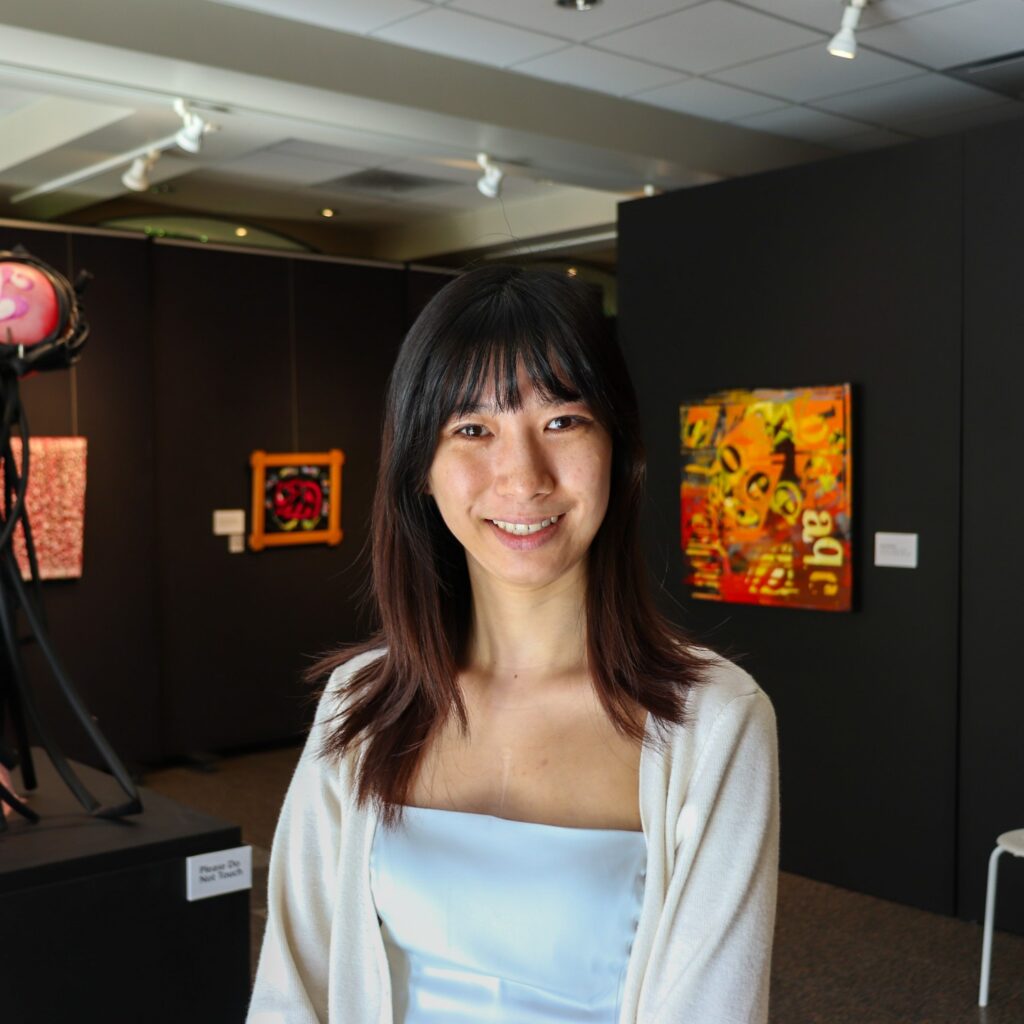
Image Description: Shanna beams at the camera wearing a pale blue silky dress with a soft cardigan overtop. She wears her long dark hair down with blunt bangs falling across her forehead. Shanna is surrounded by large bright pink and orange obscure sculptures and paintings lining the black gallery walls.

Comments Off on Staff: Shanna Cheng

Staff: Kay Slater

Title: Exhibitions and Accessibility Manager
Co-Lead: Accessible Engagement Project with Shanna Cheng
Pronouns: They/Them/Theirs
Email: kay@grunt.ca
Ask them about: Exhibitions, Access, Thursday’s Voice-Off and Low Sensory Visiting Hours, AEP, their cat Bobo. Here they share reflections on their participation in the non-verbal engagement project in 2024.

Name Pronunciation: K (like the English letter K, rhymes with day) Slay-tehr

Biography

Video description: Kay signs their bio wearing a black mock turtle-neck shirt in front of a black background. For a full visual description of Kay, scroll down the page.

Kay Slater (Exhibitions and Accessibility Manager) is a multidisciplinary artist, creative access practitioner, accessibility consultant, exhibition designer, and arts worker. At grunt gallery, they work to plan and build exhibitions alongside our exhibiting artists as a preparator with more than 10 years of experience. They are co-lead on the Accessible Engagement Project (AEP), and chair the grunt accessibility committee.

They host the bi-monthly, low-barrier, public program “How is it done? Behind the Scenes Exhibition Tours” on the last day of every exhibition exploring installation and accessibility techniques in gallery. They also host the weekly low-sensory and silent (voice-off) visiting hours on Thursday.

They enjoy working directly with artists and organizations to build accessibility in at the planning stage, and to incorporate sustainable, grass roots strategies that support evolution in artistic presentation. Their work is rooted in anti-oppression practices, and they employ open source and community-engaged approaches to support ongoing knowledge transfer with makers and creators at all stages of their careers. They proudly work with the team at Queer ASL, and have completed the Rick Hansen Foundation’s Accessibility Certification program. They are also certified as an Interpretive Specialist by the Interpretive Guides Association. Kay is passionate about sharing knowledge with the wider arts community, addressing assumptions, and embracing mistakes. Kay is a white european descendant and settler and is working to unlearn, relearn, and practice staying in their lane.

Kay is queer, mad and hard of hearing. They subscribe to the New Sincerity philosophy, which encourages people to embrace love and authenticity and to be more awesome.

Contact Information

Email: kay@grunt.ca
Kay is hard of hearing and cannot hear on the phone. Voice messages by email are fine as they will use a caption tool or email you for more information. You can also call the gallery,  604–875–9516, and leave a message. Kay is a sometimes oral speaker, choosing to go non-verbal during special projects, to respect Deaf spaces, and to respect their own hearing fatigue. They lipread, use live captions, and text message to communmicate.

Visual Description

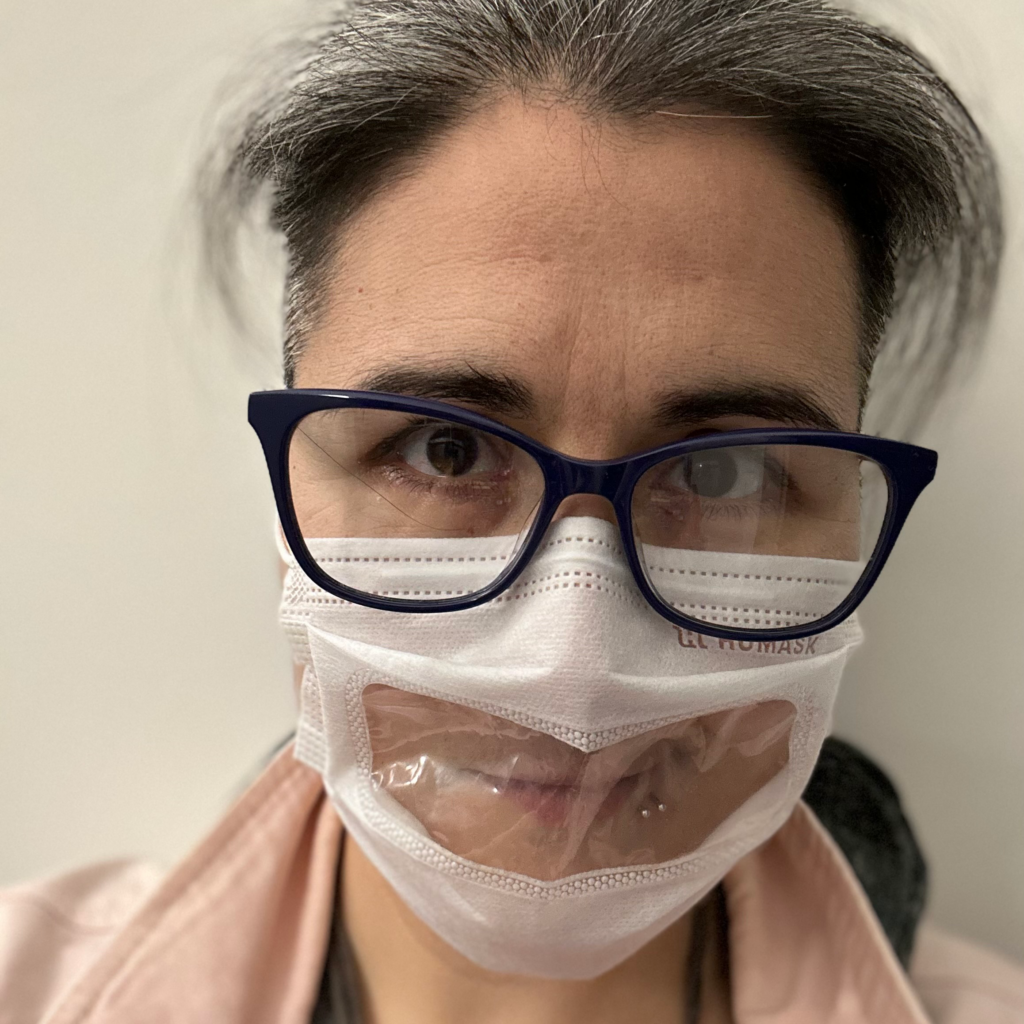
Kay is a white, middle-aged person with back-length hair the colour of wet West Coast sand. Their hair is shaved at the sides and back, and they often wear it up and away from their face. They have cow-brown eyes, a triple-pierced nose, double-pierced lip, and large, rosy cheeks. They have a yellowed, tea-stained, teeth-exposing smile that crinkles the corner of their eyes. They are of average to large build and stand 5’6 or 168 cm. Their figure reads as femme, and their clothing is neutral and casual in colour, fabric and style. Kay’s typically fingerspells their name in a quick cursive K-A-Y.

Image Description: Kay’s hair is pulled back with short hairs coming out of a bun above their shaved sides. They wear oversized plastic glasses and a face mask with a plastic visor that allows for lip reading.

Leave a comment

Job: MPCAS Curator

Position: MPCAS Curator 

Project: Mount Pleasant Community Art Screen

Reporting to: Programming Team

Hours: 15 hours per week. Occasional evening and weekend work. Flexible schedule. This is a 1 year contract position.

Remuneration: $27.00/hr

Start date: July 1, 2023

About the Mount Pleasant Community Art Screen and grunt gallery:
The Mount Pleasant Community Art Screen (MPCAS) is a 7m x 4m outdoor urban screen located at the intersection of Kingsway and Broadway in Vancouver on the side of the Independant building, a mixed use commercial and residential tower. The screen is maintained and programmed by grunt gallery, and aspires to enrich and engage the public through the presentation of media art that reflects the diversity, historical richness and creative capacity of the Mount Pleasant neighbourhood.

Through an annual submission call, commissions, co-productions and partnerships, the screen features works for and about Mount Pleasant and the people who live here alongside programming that connects these local issues to global practices, ideas and concerns. The MPCAS is a place for media and interactive content both home-grown and far-flung, presented through the distinctive lens of the neighbourhood.

grunt gallery has been a part of the Mount Pleasant community since 1984 and has seen tremendous changes over this period. During the past 40 years the area has gone from one of Vancouver’s poorest neighbourhoods to one of its richest. This transition hasn’t been easy and the social costs of thirty years of gentrification have been intensifying, particularly with the Broadway Plan and incoming skytrain stations reshaping the area. MPCAS has been born of this tension and we seek to acknowledge both the Mount Pleasant that is being forced out and the new communities coming into being.

General Description of the Position: 

The MPCAS Curator works with the grunt programming team and Program Director, as well as  community partners to develop contacts and strengthen relationships between the MPCAS and its partners in the community.

The MPCAS Curator is a planner, implementer, and relationship builder who is responsible for maintaining existing programming and developing new initiatives that reflect the multiple and diverse communities in Mount Pleasant. They will take the lead in the curatorial vision of the screen, coordinating our annual submission call while cultivating partnerships with other art organizations and local festivals year-round. We expect this to take the shape of developing new projects and applying for funding opportunities to support them and in in-kind exchanges with community partners.

We are looking for a candidate who prioritizes developing local relationships and familiarizing themselves with the neighbourhood’s history, businesses, community organizations and art communities. They will work with grunt staff to develop strategies that bring community content to the screen, promote visibility and encourage broad access.

The MPCAS Curator is expected to work independently, but will play a key role in the grunt programming team, alongside the Program Director, curatorial staff and the technical manager.

Required Competencies:

Collaborative
Reliable
Committed
Independent
Community Minded
Resourceful
Creative
Flexible
Social
Communication

General Responsibilities: 

  • Work with staff and committees to develop strategies and enhance contacts within the Mount Pleasant community in conjunction with the MPCAS’s vision for programming and the neighbourhood.
  • Design and implement a curatorial vision that builds strong, long-term, and loyal relationships with audience members, supporters and communities.
  • Develop programming for the MPCAS engaging heritage and cultural communities as well as community groups, seniors, youth and more.
  • Continue to develop relationships with partners and collaborators from the xʷməθkʷəy̓əm (Musqueam), Skwxwú7mesh (Squamish) and Səl̓ílwətaʔ/Selilwitulh (Tsleil-Waututh) Nations as well as the wider Indigenous communities of Vancouver.
  • Collaborate and communicate with neighbourhood organizations to develop activities that promote the MPCAS’s presence (eg. community events and festivals such as Car Free Day, and organizations such as the Mount Pleasant Neighbourhood House, Tonari Gumi, the Native Education College and many others). Previous partnerships have included limited run screenings with the Capture Photography Festival, VQFF, Room Magazine and other community based programming.
  • Create content around programming and community engagement for the MPCAS’s social media and website. Collaborate with grunt’s Communications Manager as required.
  • Update the MPCAS website and internal content management system.

Required Skills and Education: 

  • Awareness of and experience working within the Mount Pleasant neighbourhood.
  • Strong knowledge and commitment to bridge-building within diverse community frameworks.
  • Strong written and oral communication skills; ability to target outreach materials to varying audiences and age groups; ability to listen, and bring strong awareness of interpersonal/ intercultural dynamics.
  • Good understanding of artist-run culture.
  • Ability to (or interest in developing skills to) write grants, and find alternative funding support for innovation.
  • Post-secondary education or experience in community engagement, public programming, communications, activist organizing or arts-related disciplines is an asset.
  • Some knowledge of media art practices and production requirements.
  • Familiarity with Media and Video Arts.
  • Some knowledge of public art (and public messaging in relation to art in the public realm) an asset.
  • Some experience with social media content creation and CMS/Wordpress.
  • Familiarity or interest in project development and management.
  • Ability to perform well in a team environment and collaborate with others.
  • Strong organizational skills, able to identify and prioritize tasks with minimal supervision, work independently, and take initiative.
  • Resourceful, hands-on and pro-active.
  • Proven ability to act in an assertive but professional manner and to represent oneself and an organization in a positive manner.
  • Ability to work flexible hours.

Ethics and the Workplace: 

  • The MPCAS curator must be invested in open communication and collaboration.
  • Acknowledging that most accepted definitions of professionalism have racist origins, the MPCAS curator will be able to be present and engage in their work in a manner that is dedicated and as consistent as possible.
  • We envision this role as one best served by working artists and creatives with their own on-going practices to consider this role; we hope to develop a working relationship wherein artists can exist both as artists and arts workers, and will be in conversation with the successful applicant on what grunt can do to support their on-going career.
  • As a junior position, we strongly encourage emerging artists and curators to apply.

To apply: Please send cover letter and resume to Whess Harman by email at whess@grunt.ca

Application Deadline: May 26, 2023 @ 5:00 pm PDT


Comments Off on Job: MPCAS Curator

Job: grunt gallery Program Director

Job Posting

Position: Program Director

Location: grunt gallery

Reporting to: Board of Directors

Term: Full-time, permanent 35 hours/week. Some evening and weekend work. Flexible schedule.

Start Date: July 15, 2023

Click here to access a PDF of this job description.

Audio recording of this job description coming soon.

About grunt gallery:

Formed in 1984, grunt gallery is an artist-run centre located in the Mount Pleasant neighbourhood of Vancouver, BC. grunt gallery has built its reputation on innovative programs that showcase current and past work by contemporary Canadian and international artists. Working with a wide range of collaborators, grunt gallery confidently supports interdisciplinary projects, performance, media works, publications, websites, artist talks, research residencies, mentorships, publicly-sited projects and socially-engaged initiatives alongside gallery-based exhibitions. grunt gallery continues to provide space for artistic agency, diverse perspectives, unruly practices and community connection. The gallery operates a wide variety of programming and initiatives, including those stemming from the Exhibitions, the Archive, Accessibility and Public Engagement, Events and Special Projects.

grunt has experienced significant growth over the last three years. Our programs have expanded and our staff team has grown at the same time as we continue to reflect on our role in community, and our commitment to anti-oppression work in the arts. Working at an increased scale and scope while prioritizing social justice, community engagement and creative access/accessibility initiatives, the organization seeks to create opportunity and impact in this region, in keeping with the priorities and guidance of the Musqueam, Squamish and Tsleil-Waututh host Nations.

We are looking for a Program Director who shares this sense of commitment, and who can embrace the complexities of working strategically in the public realm alongside the quieter work of relationship, self-reflection and collaborative leadership. We continue to do the work of articulating our emergent approach to arts-work, and we invite your vision into the organization at a key moment in our development. We understand new leadership may come from places we can’t predict, and we hope this opportunity can include those who, upon first glance, may not see themselves in a directorship role. We have a strong history of supporting Indigenous, Disabled/ Sick/ Mad, BIPOC and LGBTQIA2S+ artists and creative thinkers into leadership, and we offer investment in this imaginative potential.

The Program Director has a strong background in the visual arts community, with extensive knowledge of the local art community, and will work collaboratively to deliver the curatorial vision of the organization. The Program Director is highly motivated to build relationships with funders, foundations, donors, members, artists, and patrons.

The ideal candidate will be comfortable working with a talented and empowered staff team to ensure the core values of the organization are integrated at every level. The Program Director upholds the organization’s values and artistic vision and leads strategy for the organization. The Program Director is committed to anti-oppression and trauma-informed work, accessibility initiatives, fair treatment of artists and cultural workers, and supports and values emerging artists and emerging practices.

Required Competencies:

Creativity
Community
Collaboration
Commitment
Budget Development
Communication
Flexibility
Negotiation
Networking
Reliability
Grant Writing
Mentorship
Accessibility
Conceptual Thinking
Equity

Responsibilities:

  • Works in a co-directorship model with the Operations Director to provide artistic, strategic, operational and financial direction to the organization, ensuring the needs of the organization are met effectively and collaboratively.
  • Upholds the artistic vision of the organization and works closely with staff to determine the artistic and strategic direction of each department, build narratives for grant writing and seek funding to support a variety of projects.
  • Works collaboratively with the Curator, artists and partner organizations to determine and facilitate exhibition-based programming and special projects.
  • Responsible for long-term strategic planning of the organization.
  • Provides financial management and oversight, including budget forecasting and tracking, investment management, and long-term financial strategy.
  • Responsible for extensive grant writing for operations and special projects.
  • Responsible for developing key connections, partnerships and collaborations inside and outside the arts community in order to support and build the annual operations and programming plan.
  • Builds grunt’s community reputation via networking, development and community engagement.
  • Develops and maintains relationships with public and private funding sources, and has a strong interest in donor development and fundraising.
  • Reports directly to the Board of Directors and attends monthly board meetings to provide strategic, financial and programming updates.
  • Supports and leads the staff team, putting grunt’s shared values, mandate, and public image at the forefront.
  • Other duties as required.

Required Skills and Education:

  • Passionate about collaborative leadership, organizational development, artistic visioning, strategic planning, partnership building and networking within the visual arts community.
  • Excellent understanding and experience of working within the visual arts community and with artists.
  • Familiar and comfortable navigating local, national and international art communities.
  • Excellent understanding of artist-run centres and non-profit policies and requirements.
  • Ability to uphold and drive grunt’s vision.
  • Post-secondary education in an arts related field or a combination of relevant education and work experience must be demonstrated.
  • Proven ability to develop, maintain and work within departmental and operational budgets with demonstrated cost-savings experience.
  • Proven track record of successful grant writing.
  • Shared organizational values.
  • Experience working in community and embodying the role of ‘storyteller:’ able to synthesize complex ideas and rich histories for broad audiences.
  • A collaborative and attentive leader who is able to lift up and support a talented and empowered staff team.
  • An understanding that grunt is a “people-centered” work environment that respects a variety of working styles that uphold and align with grunt’s values, and thrives on communication to allow for creative autonomy and decision making amongst staff.
  • A working intercultural skill-set to effectively work with diverse groups of people including staff, board, artists and community members, and a history of engagement with Indigenous and LGBTQIA2S+ people.
  • Commitment to accessibility initiatives beyond an accommodation mindset.
  • Exceptional communication and coordination skills to ensure all aspects of complex projects are carefully planned and can be effectively understood by collaborators.

  • Must be highly organized, detail oriented, committed to quality and able to work independently with minimal supervision.
  • Ability to work flexible hours.

Remuneration: $70,000 per year with additional benefits:

  • Following a 90-day probationary period, enrollment in employee benefits program
  • Annual travel/research budget
  • Annual professional development budget
  • Hybrid office/work-from-home model
  • Three weeks paid vacation
  • Additional paid days off during office-wide closures (one week in August; two weeks in December)
  • Ten sicks day annually

How To Apply:

Please forward your cover letter and C.V. to: meagan@grunt.ca

Preferred file format is PDF.

Please email meagan@grunt.ca should you require any accommodations for this application process or to discuss your access needs.

Application Deadline: Friday May 19, 2023 @ 5:00 pm PDT

grunt gallery welcomes, encourages, and is actively seeking applications from members of equity deserving communities such as (but not limited to) people from racialized communities, Indigenous peoples, persons with Disabilities, women, gender-diverse and LGTBQIA2S+ people, and others with the skills and knowledge to productively engage with diverse communities.

It is our hope that this position will encourage working artists, or creatives with an on-going practice, to consider this role. We hope to develop a working relationship wherein artists can exist both as artists and arts workers, and will be in conversation with the successful applicant on what grunt can do to support their on-going career.

grunt gallery is located on the unceded and ancestral territories of the xʷməθkʷəy̓əm (Musqueam), Skwxwú7mesh (Squamish) and səlilwətaɬ/selilwitulh (Tsleil-Waututh) Nations of the Coast Salish peoples.

Comments Off on Job: grunt gallery Program Director

Hillary Wood Memorial

You are invited to grunt gallery’s memorial for Hillary Wood (December 25, 1948 – March 2, 2023), a dear friend, founding member, and beloved presence in the Vancouver arts community. All are welcome.  

The memorial will take place at grunt gallery located at 350 East 2nd Ave, Unit 116 in Vancouver (street parking available) on Sunday April 30th, 2023, from 1pm – 4pm. Remarks at 1:30pm, open to all. Drinks and light refreshments provided.

There will be a virtual gathering option as well. Please click here to join via Zoom, and enter the passcode 156732 for access.

grunt will prepare a slideshow presentation with images of Hillary and her artwork. If you have any digital images you would like to contribute please email them to Dan Pon, dan@grunt.ca. If you have any hard copy images you would like digitized and included please email Dan to make arrangements as soon as possible. You are also welcome to send quotes, memories, or other written tributes which will be included as text slides to the email above.

Masks are encouraged and provided on request.


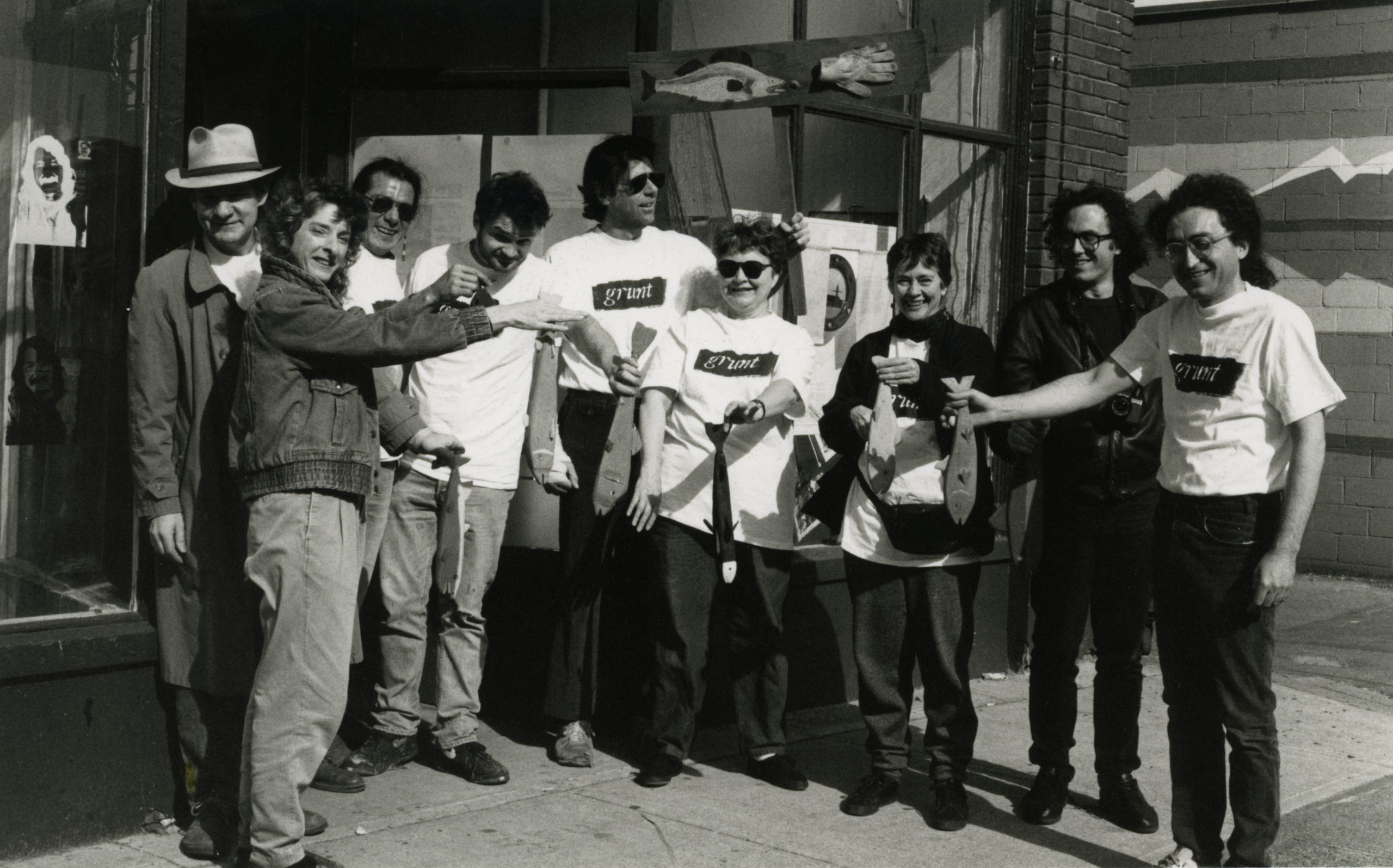
Image: Hillary Wood with Joe Haag, Aiyyana Maracle, Edmund Melynchuk, Kempton Dexter, Barbara Seamon, Polly Bak, Phillip Beeman, and Glenn Alteen, For the Life of Art March/Arts Awareness Day, 1993. Photo by Pat Beaton.

Comments Off on Hillary Wood Memorial

Annual General Meeting 2022

NOTICE OF ANNUAL GENERAL MEETING

Visible Art Society (dba grunt gallery)


DATE: Thursday September 29, 2022
TIME: 6:30pm
LOCATION: Online
Join Zoom Meeting: https://us06web.zoom.us/j/86067695351

Meeting ID: 860 6769 5351

ADDRESS: #116 – 350 East 2nd Avenue, Vancouver, BC, V5T 4R8, Mainspace Building

Please join us for a fast and fun Annual General Meeting of the Visible Art Society (dba grunt gallery) by Zoom.  We will be meeting for the following purposes:

  1. Presentation of the 2021 – 2022 audited financial statements
  2. Board of Directors’ report
  3. Program Director and Operations Director reports
  4. Election of the society’s officers

Click here to access the 2022 AGM package. 

As a member, you are invited to attend virtually and vote.  If you are not a member, please go to grunt.ca and sign up for our newsletter by 5:00pm on September 28, 2022. There is no cost to membership.

Comments Off on Annual General Meeting 2022

Cree & D

After many trials and several travels in the great iron birds that skim across the skies and over the canopy towns in the realm of Ministik—wait, wherefore and what-now is Ministik? We’re thrilled to invite you into a new project written by Jessica and Ben Johns. Cree & D has been percolating in the background like the healing tonic of a strong, home-brewed yarrow kombucha. Written in the style of a Dungeons & Dragons campaign, this is a story of love, family, and of course adventure, as these aunties work to preserve the hard won and tenuous peace treaty between the six nations. There’s also Butterball, Auntie Darlene’s werepug familiar.

The first episode of Cree & D launched in August 2022! This campaign follows the story of three cuzzins—Auntie Vera, Auntie Darlene and Auntie Mac—as they search for Kokum Cardinal’s stolen staff and work to preserve the peace in the realm of Ministik. Listen on the player below or follow our channel on PodBean: click here!

Cree & D is produced by These Ones (formerly known as Together Apart) and supported by grunt gallery on the unceded territories of the Musqueam, Squamish and Tsleil-Waututh peoples. We record on Treaty 6 at FAVA studios. Art by Abbey Riddle. Music by Matthew Cardinal. Voices by Ben and Jessica with Emily Riddle and Matt Ward.

Image by Abbey Riddle.

Comments Off on Cree & D

Skip to toolbar